
Andalusia in June and July: The Honest Guide by Wingman
Every travel guide about Andalusia in summer says the same thing: go in spring, avoid July. This one says something different. June is outstanding, July is possible if you know what you are doing, and the travellers who understand the heat are having the best time in the region while everyone else is arguing about it online.
The honest version of this guide: Seville in July at 2pm is genuinely not enjoyable. The Alhambra sells out in summer. The Costa del Sol beaches in August feel like a European airport with sea access. All of that is true. What is also true: June in Andalusia is one of the best months to travel in all of Europe right now. July has a coast and a culture that makes the heat manageable if you plan around it. And Ronda, Cádiz, and Málaga are superb in both months regardless of the temperature.
Here is how to actually do it.
Average high temperatures across Andalusia — city by city
The table makes the strategy obvious. Cádiz and Málaga are coastal and consistently 8–12 degrees cooler than Seville and Granada. June is manageable everywhere. July is a coast city month for those who want Seville, unless you follow the locals’ schedule precisely.
June versus July — what actually changes
The locals do not avoid summer. They reorganise around it. The traveller who adjusts their schedule by four hours experiences an entirely different Andalusia to the one who keeps Northern European timing.
Where to go and what Wingman has for each
Seville in June is one of the best city travel experiences in Europe — full stop. The Santa Cruz quarter at 8am, when the tiled lanes are still cool and the cathedral casts long shadows across the Giralda, is exactly what every travel photograph tries to be. The Alcázar palace (still a working royal residence) has the most extraordinary Mudéjar architecture in Spain. The Triana neighbourhood across the river is real Seville — tile workshops, flamenco bars, the morning market.
In July, the city belongs to the early mornings and the late nights. Midday in Seville in July is not a comfortable experience for most visitors. But 10pm on the Alameda de Hércules, with the city finally cooling and the bars full, is the version of Seville that Sevillanos themselves actually live in.
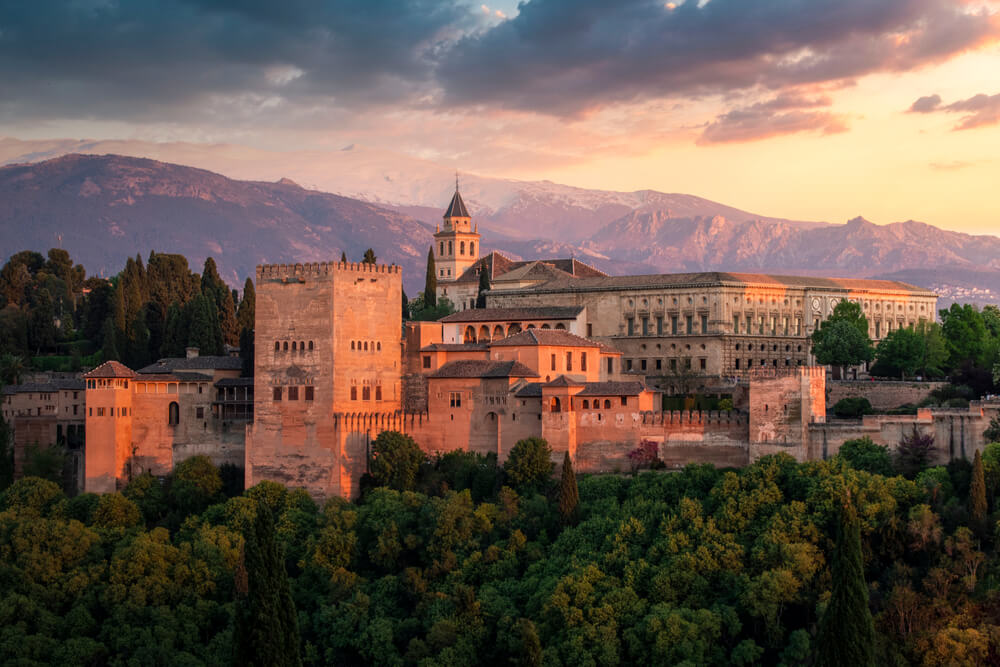
The Alhambra is the reason most people come to Granada and the reason most people are disappointed — not by the palace itself, which is genuinely astonishing, but by the planning. In June, Alhambra slots are bookable 2–3 weeks ahead. In July they sell out 6–8 weeks in advance. Book before you book your flights. There is no walk-in option.
Granada’s International Music and Dance Festival runs through June and July — evening concerts in the Generalife gardens of the Alhambra, with the palace illuminated behind the performers. This is the version of the Alhambra that most tourists never see and cannot get tickets for because they did not know it existed. Wingman’s Granada walking tour covers the Albaicín — the Moorish quarter below the palace — with audio context on the 800-year Muslim history that shaped the neighbourhood.
Ronda sits at 723 metres above sea level, which makes it 6–8 degrees cooler than Seville or Córdoba in the same month. The Puente Nuevo bridge spans the 120-metre El Tajo gorge that divides the old city from the new — it took 42 years to build (1759–1793) and 50 workers died in the construction. The view from the bridge, down to the river below, is one of those moments that photographs fail to communicate.
Ernest Hemingway and Orson Welles both spent significant time in Ronda. Welles asked to have his ashes buried near the city’s bullring — the oldest in Spain, built in 1784. Rilke wrote some of his finest letters here. The city has attracted writers and painters for two centuries for a reason that becomes obvious within an hour of arriving.
12 Andalusia tours. The whole region planned in 45 seconds.
Seville flamenco walk, Granada Albaicín route, Ronda photowalk, Cádiz coast guide, Málaga Picasso tour, Córdoba through the ages. Generate your full Andalusia itinerary — multi-city, day-by-day, audio at every stop. Free.
Download WingmanCádiz is, by most historical accounts, the oldest continuously inhabited city in Western Europe — founded by the Phoenicians around 1100 BC, which makes it older than Rome by several centuries. It sits on a narrow peninsula on the Atlantic coast, surrounded by water on three sides, which keeps it 8–10 degrees cooler than Seville in July. The Atlantic wind the locals call the Levante comes off the sea in the evenings and the city becomes, genuinely, the best place to be in Andalusia when the inland towns are at peak heat.
The Mercado Central de Abastos — the covered market — is the food heart of the city. The best seafood in Andalusia is here, not in the tourist restaurants on the waterfront. Chicharrones, ortiguillas (sea anemones, fried), and the fish market at 7am before the stalls sell out are the reasons chefs travel to Cádiz specifically.
Málaga spent decades being treated as a transit city — the airport for the Costa del Sol, somewhere you passed through on the way to somewhere else. The city has spent the last ten years becoming somewhere people come to stay. The Museo Picasso Málaga (in the Palacio de Buenavista, where Picasso’s family lived) is one of the best single-artist museums in Europe. The Alcazaba Moorish fortress above the city gives the same kind of view that the Alhambra does, with a quarter of the visitors and no requirement to book months ahead.
Córdoba in July reaches the highest temperatures in mainland Spain — regularly 38–42°C. This is not a comfortable city for July afternoons. It is, however, worth organising your itinerary around precisely because the Mezquita-Catedral — the mosque that became a cathedral while remaining, architecturally, both — is among the most extraordinary buildings humans have ever constructed. The forest of 856 columns, the double-tiered arches in alternating red and white, and the incongruous Renaissance choir inserted into the mosque’s heart in the 16th century are a three-century argument about religion and architecture visible in a single building.
Go at 8am when it opens. Be inside by 9am. Leave by 11am. Return for the Judería — the medieval Jewish quarter — after 6pm when the temperature drops. Córdoba is entirely worth the planning required to do it right in summer.
The June and July Andalusia strategy
The travellers who have the best summer in Andalusia all do essentially the same thing. They base themselves in a coastal or elevated city — Cádiz, Málaga, or Ronda — and use the train network to make day trips to the inland cities in the early mornings. Seville from Cádiz is two hours by train. Granada from Málaga is an hour and a half. Córdoba from anywhere is worth the early departure if you are back in your coastal base by early afternoon.
The key Wingman feature for this kind of trip is the multi-city itinerary builder. Type your base city and your travel days, indicate that you want to include Seville, Córdoba, and Granada as day trips, and the app builds the routing with walking times and stop priorities at each city. The 12 Andalusia audio tours are distributed across all six cities — meaning whichever combination you choose, the full context is there when you arrive. Every tour is free. None of them require a booking, a guide, or any prior knowledge of the region.